
← All speakers ▶ Watch ↗
 ▶ Watch ↗
Thariq Shihipar
Conference affiliation: Claude Code · Anthropic · 2026
Related work and projects
Thariq Shihipar works at OpenAI. At Anthropic, he introduced AskUserQuestion on the Claude Code team. The tool lets a coding agent pause and present choices when it needs the user to make a decision. Thariq later ran into that problem in his own fighting-game prototype. An agent could implement a character’s move before he had decided how it should play. Claude Code fireside chat · The Sweet Side of the Bitter Lesson
On this page
From making game maps to building tools for creators
Thariq learned to program by making and sharing Warcraft III maps as a teenager. The editor let him invent new rules using the game’s existing engine, art, and controls. Seeing someone play one of his maps showed him what a game editor with built-in distribution could make possible for a beginner. As a University of Toronto undergraduate, he co-founded Chime with Fahd Ananta and Guru Mahendran. Their Chrome extension gathered email and social notifications into one stream. HubSpot acquired Chime in 2013, and Thariq went on to help establish its Signals sales-software team. How Modding Games Changed My Life · Chime acquisition · Career history
Thariq began graduate study at the MIT Media Lab in 2014 and stayed on as a research scientist after his master’s work. Alongside news visualization work on NewsClouds, he co-founded PubPub with Travis Rich and served as its engineering director. PubPub let authors revise research after publication, readers annotate and discuss it, and publishers put executable examples alongside the text. The Media Lab and MIT Press used the platform for the open-access Journal of Design and Science. MIT Media Lab · PubPub project · Journal of Design and Science
After developing products for clients at Rocket Insights, Thariq built Edgeout.gg, an analytics platform for professional League of Legends teams. He built a tool to collect data from games in progress for analysis. Blitz acquired the platform. In 2019, Thariq co-founded One More Multiverse with Hisham Bedri and illustrator Sara Alfageeh. The company joined Y Combinator’s Winter 2020 batch and built a browser-based system for making and sharing tabletop-inspired games, with illustrated worlds and a marketplace for creator-made assets. As CEO, Thariq led a team of about 30 across engineering, art, design, product, and marketing. He says the platform reached more than a million users. Career history · One More Multiverse
From model features to Claude Code
During a Goodfire research fellowship, Thariq worked on automated interpretation and visualization of model features. He co-authored a study that used sparse autoencoders to identify features in Llama 3.3 70B and map them for exploration. In one experiment, turning up a feature made the model write like a pirate. At higher settings, factual accuracy degraded even as the model-based evaluator continued to score the output highly. Thariq’s own writing explored whether feature steering could help developers tune style, express preferences, or classify text, and how poorly understood features or interactions between them could undermine those uses. In a separate experiment on semantic sorting, he used a language model to compare small batches of items and TrueSkill to update their ratings and uncertainty. New items could enter the ranking without rerunning every comparison. Goodfire’s feature map · Should Developers Care about Interpretability? · LLM-Powered Sorting with TrueSkill
Thariq credits an interpretability visualization he built and shared with getting him an introduction at Anthropic. Around the release of Opus 4, a friend encouraged him to try Claude Code. Using it made him want to work on it. He joined the team in June 2025, while One More Multiverse was winding down. Interview with Ryan Peterman · Claude Code fireside chat · Thariq’s account of the transition
What agents can investigate and what they need to ask
- Use the filesystem to make work checkable. Thariq used a question about ride-sharing expenses to show what Bash and files give an agent even outside coding. It can save the receipts it finds, calculate a total with a script, and trace each number back to the original message. Discovering commands takes time, and generated code may need compilation and testing. He favored dedicated tools for actions such as editing a file or sending an email when the application needs to recognize the action and show it for approval. Claude Agent SDK workshop
- Give agents local knowledge when they need it. In Thariq’s writing on skills, a skill is a folder the agent can discover and open as needed. It can contain reference material, scripts, and details learned from repeated mistakes. A billing skill might explain which version of a subscription record to use or where to confirm that a payment went through when a successful HTTP response tells only part of the story. He recommends spelling out the goal and constraints and letting the agent adapt the steps to the situation. Lessons from building Claude Code: How we use skills
- Check the work where a mistake can occur. Thariq favors deterministic checks that give the agent something concrete to fix. He points to Claude Code rejecting an attempted edit when the agent has yet to read the file, and to compilation, linting, and assertions for checking the result. For model-based review, he prefers giving the reviewing agent fresh context so it can question the assumptions behind the work. He also weighs how easily an action can be undone. A Git revision can be restored, while recovering from a change to an external service can require further actions. Claude Agent SDK workshop
Thariq had to tune AskUserQuestion to get Opus 4 to call it. With Opus 4.5, he could ask the agent to interview him about a specification. Later models could generate an HTML report that put questions beside the information needed to answer them. He uses interviews to surface decisions that could change the architecture and contrasting prototypes to uncover design preferences he can articulate once he sees them. When the agent fills in a gap during implementation, he asks it to record the decision so he can review it and explain the resulting change himself. Field Guide to Fable
He also found that a technique that helped one model could constrain the next. Examples helped earlier Claude models follow instructions, but the Claude Code team found that examples could narrow the approaches Opus 4.8 and Fable considered. Thariq describes giving those models more background and fewer blanket prohibitions, which could conflict with instructions from a user or a skill. He reconsidered software rewrites for a similar practical reason. Agents made reimplementation easier, and a strong test suite could pin down behavior that might otherwise survive only in the old code. He argues that planning a rewrite can help a team uncover and test behavior documented only in the old code. Claude Code fireside chat · Simon Willison’s speaker-attributed account
Keeping a hand in the game
At One More Multiverse, speeding up the app and prototyping a feature could compete for weeks of engineering time. When Thariq later revisited the codebase with an agent, some work he would have budgeted weeks for took hours. He missed writing code by hand and holding a codebase in his head. He also remembered late nights debugging and projects that went nowhere. The experience made him more willing to test old assumptions about what his team could attempt, and left him with a founder’s distinction between building something quickly and finding something people value. Field Guide to Fable
Thariq announced on October 24, 2026, that he had left Anthropic after more than a year on Claude Code. By then he was already prototyping an isometric fighting game and trying to get the feel of its characters right. One could summon a wall and throw rocks, but a prompt to implement the throw left open questions about whether a rock could pass through the wall or how charging the move should change it. The agent made those choices while Thariq’s attention was elsewhere. When he played the result, he struggled to explain his own character’s rules. Departure announcement · Fighting-game prototype · The Sweet Side of the Bitter Lesson
He split the prototype into an engine the agent could work on and a readable game specification he could edit himself. The specification is executable code, organized around characters and named abilities, with parameters expressed in units such as meters. He can read the logic for a charged throw, change the rock’s size in his editor, and see how it feels in play. The agent can still build the lower-level operations the specification needs. The arrangement gives him a way to work directly on the part of the game he wants to understand and tune. The Sweet Side of the Bitter Lesson
The prototype also shows how his view of agent interfaces changed. Thariq had expected Bash and command-line interfaces to dominate and worried that models’ fluency in React would push designers toward a single stack. He came to prefer the Model Context Protocol for connecting agents to tools and saw capable models produce mockups in HTML, React, or Figma. He calls that breadth the smooth interior of the jagged frontier. At the limits, capabilities still vary sharply across tasks. For work the model handles comfortably, there may be several good ways to get the result. That gives him a choice about where to work. In his game, the useful interface is the one that lets him read and change how the character moves. The Sweet Side of the Bitter Lesson
Topics covering these talks
Talks by Thariq Shihipar
4 talks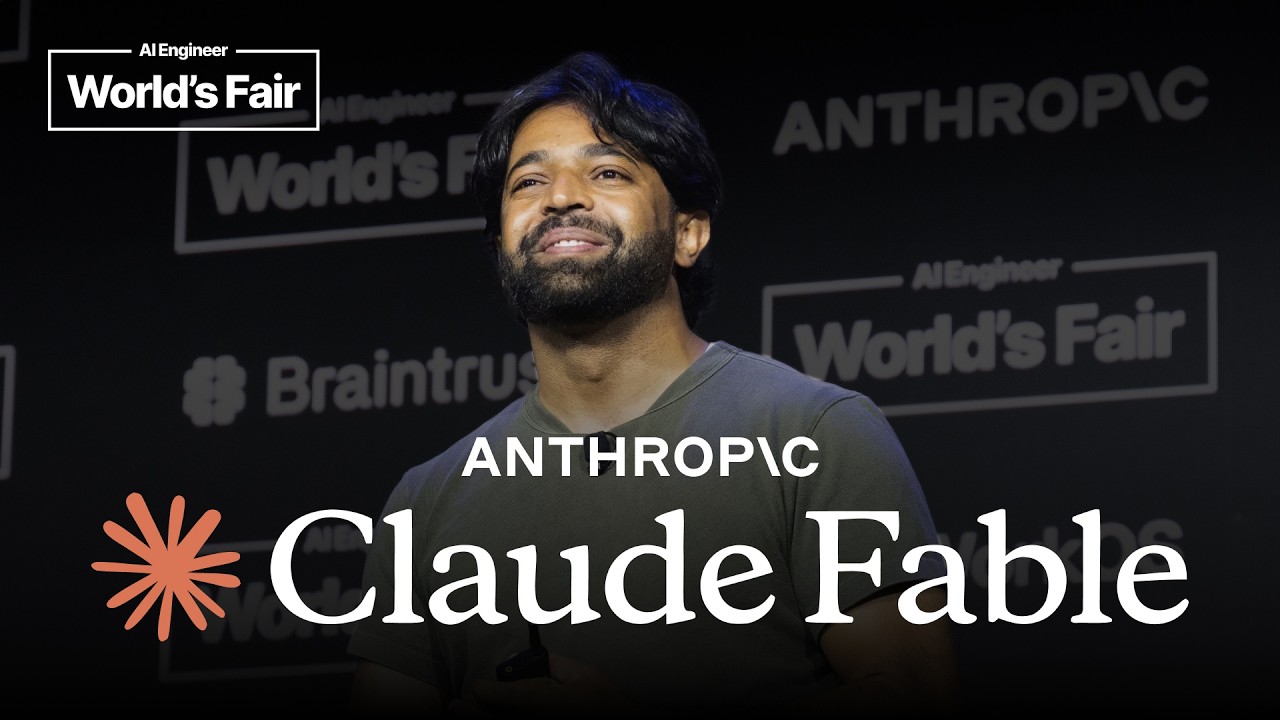 ▶ Watch ↗
Popular #241:52:25
Claude Agent SDK [Full Workshop] — Thariq Shihipar, Anthropic
Explore the talk →▶ Watch ↗AI Engineer World's Fair 202651:30
Claude Fable, Claude Tag, and Anthropic's Culture — Cat Wu & Thariq Shihipar ft Simon Willison
Explore the talk →
Loading more talks and highlights…
References
- ai.engineer/talks/claude-agent-sdk-workshop ↗
- ai.engineer/talks/claude-fable-claude-tag-and-anthropic-s-culture-cat-wu-thariq-shihipar-ft-simon-willison ↗
- ai.engineer/talks/field-guide-to-fable ↗
- thariq.io/blog/sorting/ ↗
- thariq.io/blog/interpretability/ ↗
- ai.engineer/worldsfair/2026 ↗
- ai.engineer/code/2025 ↗
- youtube.com/watch ↗