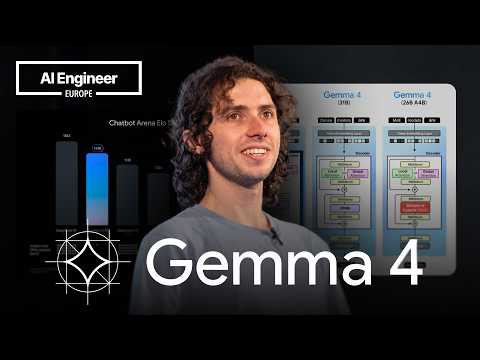
Omar Sanseviero leads developer experience at Google DeepMind, overseeing how developers build with AI Studio, the Gemini API, and Gemma. His career spans Google’s machine-learning infrastructure, Hugging Face’s open-source platform, and research on making capable AI models easier to run, evaluate, and adapt.
Sanseviero interned with Google Cloud and Google Assistant before joining the Assistant team in Zurich, where he worked on model deployment, distributed feature extraction, and model quality. He also took on product-management responsibilities with TensorFlow Graphics and co-founded AI Learners, a Spanish-language machine-learning education community.
He subsequently joined Hugging Face as a machine-learning engineer, helped develop its developer-advocacy organization, and eventually led platform and community initiatives as Chief Llama Officer. His contributions included launching Hugging Face Spaces, building open-source integrations, and overseeing teams spanning developer advocacy and applied research.
Open models should run on everyday hardware. Sanseviero advocates compact multimodal systems capable of offline coding, mobile agents, and parallel local inference. Running models on phones or laptops lowers infrastructure requirements while giving developers greater control over sensitive data and customization.
Model architecture determines practical deployability. In his AI Engineer Europe keynote, he detailed how Gemma’s E2B and E4B variants use per-layer embeddings that can reside in CPU memory or on disk. Offloading those components through llama.cpp reduces pressure on GPU memory and makes capable on-device inference more practical.
Evaluation must reflect real deployment conditions. His guide to language-model evaluation examines how prompt formatting, quantization, implementation differences, and model-based judging can distort comparisons. He emphasizes testing against actual tasks while accounting for licensing, model size, and operating constraints.
An open model depends on its ecosystem. Sanseviero prioritizes interoperability with Hugging Face, Ollama, MLX, vLLM, SGLang, and llama.cpp, alongside specialized medical and safety models and adaptation for underserved languages. When Gemma reached one billion downloads, he emphasized the unexpected applications built by its developer community.
Gemma 4 brings multimodal reasoning and coding to local devices, with model sizes and architectures that trade accelerator requirements against latency and capability.