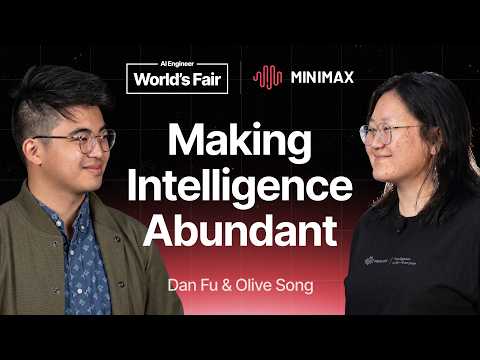
Olive Song leads reinforcement-learning research at MiniMax, overseeing the final training and release of open-weight models for coding and autonomous digital work. She focuses on making agents dependable when tools fail, environments change, tasks run for hours, and imperfect rewards invite shortcuts.
An alumna of New York University’s Courant Institute, Song lived in New York for six years before moving from academic research into industrial model development. In 2025, she helped introduce MiniMax-M2, an open-weight coding model with 10 billion active parameters. By 2026, she was leading reinforcement-learning research for MiniMax’s increasingly multimodal models, including MiniMax-M3.
Developer-centered reinforcement learning: Song incorporates experienced developers into task design, evaluation, and reward development. Their feedback grounds training in realistic debugging, repository refactoring, multilingual programming, and standards of work that software teams can actually trust.
Interleaved reasoning and tool use: Her agents alternate actions with reassessment, adapting when tool calls fail or unexpected results emerge. For extended assignments, including research reproduction and GPU-kernel optimization, she evaluates intermediate attempts and uses validation splits to distinguish genuine progress from reward hacking.
Robustness across agent environments: Song varies prompts, tool definitions, response formats, and surrounding agent scaffolds because familiarity with numerous tools does not guarantee reliable performance inside an unfamiliar production setup.
Open-weight multimodal models: With MiniMax-M3, she describes training text and visual information together from the outset, enabling agents to interpret interfaces, improve websites, navigate computers, and assist with game development. Open weights also let developers adapt models, protect sensitive data, and contribute improvements.
MiniMax’s Olive Song and Together AI’s Dan Fu connect multimodal training, useful kernel benchmarks, long-running agent evaluation and the infrastructure needed to serve them.
What happens between training a model and serving it?
Useful coding agents need more than strong benchmark scores: they must learn from developer feedback, recover from tool failures and keep working when their surrounding scaffold changes.
Olive Song explains how MiniMax paired GPU-aware sparse attention with text-and-vision training from step zero, then improved visual representations through cross-frame attention.
MSA trains a lightweight index to match main-branch attention scores, then uses its selections to restrict the keys and values the sparse branch reads.
Head-specific selection preserves GQA diversity, while block retrieval reduces top K overhead and improves GPU memory access. Efficient kernels complete the design.
In MiniMax's experiments, introducing vision from step zero almost preserved text capability under equal text-token budgets; later introduction caused degradation or sensitivity to training settings.
3D attention lets video patches interact across frames inside the ViT. Four frames gave the team's best performance–efficiency tradeoff, with reported benefits extending to some image benchmarks.
Thomas Wolf and Olive Song explain how MiniMax M3 combines sparse attention, multimodal training and coding capabilities to support agents that must read, act and keep working across long interactions.
Agents need room for accumulating tool responses and multiple interaction rounds, as well as large initial inputs.
Training text and vision together from the first step avoids difficulties MiniMax encountered when introducing vision later, while requiring work to prevent training collapse.

 ▶ Watch ↗

