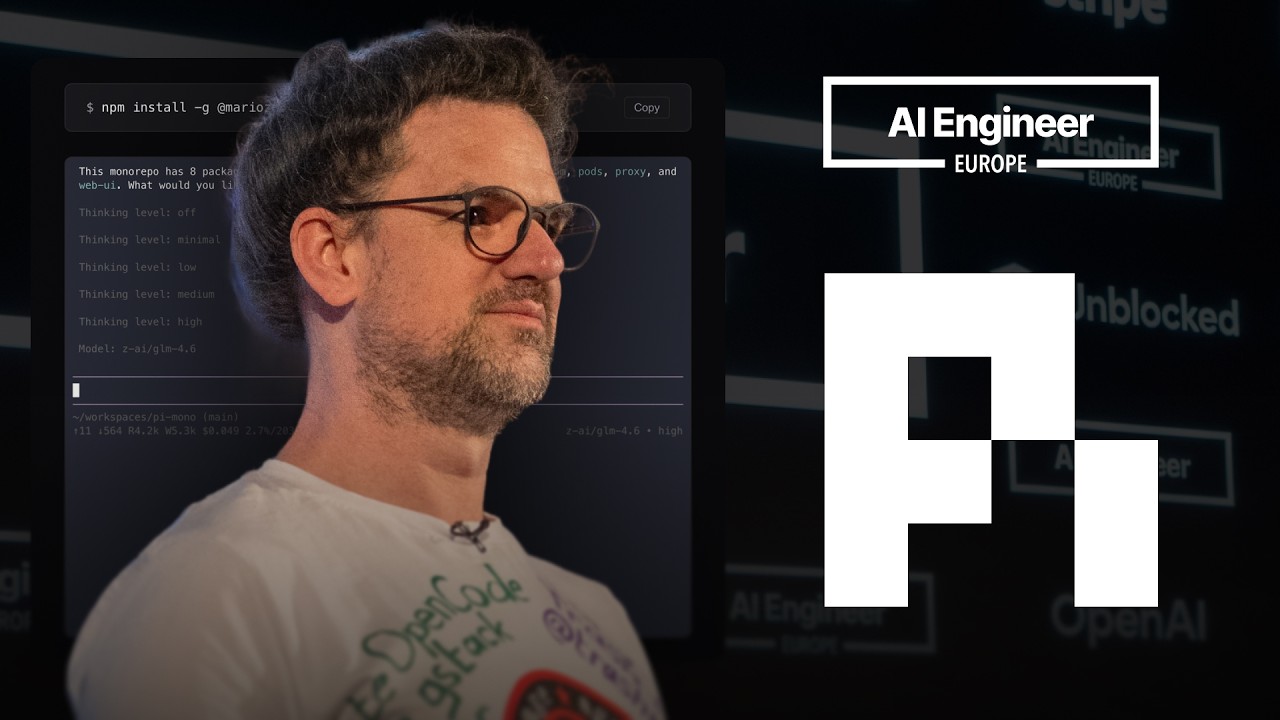
Mario Zechner created libGDX and pi, open-source tools spanning two generations of software development: cross-platform games and AI-assisted programming. At Earendil, he leads pi’s technical direction, building coding agents that developers can inspect, customize, and control.
From game development to coding agents
Zechner created libGDX, a Java game-development framework supporting desktop, mobile, and browser platforms. Its users included Ingress, Slay the Spire, and Spine, the animation software he also worked on. He originated the scene2d architecture underlying libGDX’s user-interface tools and largely transferred stewardship to the framework’s community by 2016.
He subsequently worked on RoboVM, which enabled Java applications to run on iOS, and built its first proprietary add-on: a debugger. Xamarin acquired RoboVM, closed its core, and was itself acquired by Microsoft, which shut the project down. Community contributors forked the available code, restored missing capabilities, and preserved libGDX’s iOS support through MobiVM. The experience made the practical right to fork central to Zechner’s approach to open-source governance.
Zechner built pi after finding coding assistants increasingly opaque: system prompts changed unexpectedly, tools altered model context without adequate visibility, and customization remained constrained. Its minimal architecture separates model-provider abstraction, the agent loop, terminal rendering, and the coding interface. Four default tools—read, write, edit, and shell execution—provide the foundation for TypeScript extensions that can add commands, providers, interfaces, security policies, and context-management strategies.
These self-modifying agent extensions can be generated by pi itself using bundled documentation and examples, then reloaded immediately during an active session. Zechner distributes additional capabilities through pi-skills, which also supports Claude Code and Codex CLI.
Pi reached a wider audience after Peter Steinberger incorporated it into OpenClaw’s agentic core. The resulting influx of automated, low-quality contributions prompted Zechner to require new contributors to open concise, human-written issues before submitting pull requests. He also clusters related reports and periodically closes issue trackers to protect maintainers’ time.
In April 2026, Earendil acquired pi and Zechner joined the company. He became a shareholder and retained responsibility for pi’s technical direction alongside founders Armin Ronacher and Colin Sidoti. Pi’s core remains MIT-licensed and forkable; future commercial additions may use fair-source or proprietary terms.
Principles shaping his work
User-controlled model context. Developers should understand what information reaches their models and avoid hidden prompt changes, premature diagnostics, and unexplained context pruning.
Extensibility without workflow lock-in. Subagents, planning modes, integrations, and security controls should remain optional, composable extensions instead of mandatory complexity.
Open-source maintainer protection. Automated submission volume is not community health; human-written explanations, contribution filters, and temporary tracker closures defend maintainers’ attention.
Generated code is not free. Agents can accumulate abstractions, duplication, and locally plausible changes faster than people can understand their global effects. Zechner advocates slower, more deliberate development, warns against runaway codebase complexity, and favors bounded tasks, modular systems, meaningful evaluation, and human review of critical code.