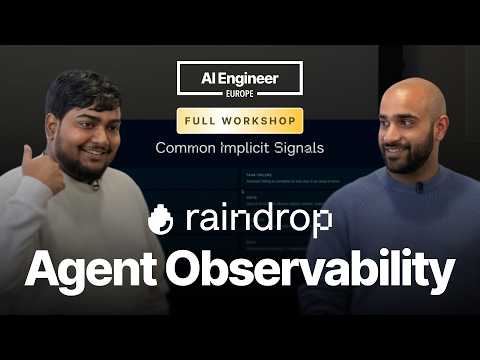
Zubin Koticha is co-founder and chief executive of Raindrop, which helps developers detect, investigate, and fix failures in production AI agents. Before building tools for agent observability, he co-founded Opyn, a decentralized-finance company acquired by Coinbase, and co-authored research on power perpetuals.
Koticha learned to code at the University of California, Berkeley, before founding Opyn with Alexis Gauba and Aparna Krishnan. In 2021, he joined Gauba, Krishnan, Dave White, Dan Robinson, and Andrew Leone to develop power perpetuals: derivatives indexed to powers of an underlying asset’s price, providing nonlinear exposure without traditional expiration dates.
He subsequently founded Raindrop with Gauba and Ben Hylak. The company joined Y Combinator’s Winter 2024 batch, initially launching Dawn, an analytics platform for AI conversations. As AI products evolved into agents capable of using tools, retaining context, and completing extended tasks, that work developed into production monitoring for autonomous systems.
In December 2025, Koticha announced Raindrop’s $15 million seed round, led by Lightspeed. The company named Replit, Speak, Clay, Framer, Tolan, Avoca, and AngelList among its customers.
- Production monitoring beyond static evaluations. Fixed test datasets cannot anticipate every interaction among tools, memory, subagents, and user behavior. Koticha argues that dependable agents require continuous monitoring of real sessions, including unexpected failures that emerge only after deployment.
- Implicit failure signals. Latency, cost, exceptions, and broken tools reveal operational problems, but can miss user frustration, inappropriate refusals, incomplete tasks, and unsafe behavior. Koticha advocates combining inexpensive pattern matching with specialized classifiers to detect these semantic failures without evaluating every interaction with another costly frontier model.
- Release experiments grounded in real behavior. Once teams can measure frustration, refusals, and task completion, they can compare prompt, model, and tooling changes against production outcomes. He distinguishes early warning signals worth investigating from formally significant experimental results.
- Turning traces into an improvement loop. Raindrop Deep Search converts natural-language descriptions of concerning behavior into reusable classifiers. Raindrop Workshop, an open-source debugger Koticha announced publicly, connects agent traces with replay and evaluation. Together, these tools advance a continuous agent-improvement flywheel: identify failures, investigate their causes, implement changes, and measure whether subsequent behavior improves.