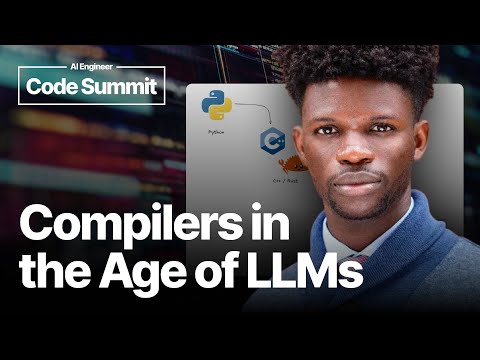
Yusuf Olokoba is the founder of Muna, where he develops software that compiles Python-based AI workloads into native code for execution across servers, edge infrastructure, and consumer devices. His work addresses a persistent obstacle in AI deployment: making models portable without requiring developers to rebuild their infrastructure around each execution environment.
Olokoba studied at Dartmouth College and worked with its Visual Computing Lab before co-founding Astorian, a marketplace connecting building owners and contractors. The startup won the NYU–Yale Pitchoff in 2018. While working with real-estate imagery, he experimented with generative adversarial networks to automate photograph editing and encountered a recurring difficulty: distributing trained models to customers.
He subsequently founded NatML, building cross-platform machine-learning tools for Unity. His other projects include VideoKit, a cross-platform media SDK, and Fill 3D, which applies generative fill to three-dimensional scenes. Unity’s IL2CPP compiler, which translates managed code into portable C++, influenced his later approach to AI infrastructure.
At Muna, Olokoba extended that portability beyond game engines. His account of developing a portable Python compiler describes translating inference code into native programs that can execute wherever compatible C++ toolchains exist.
- Ahead-of-time Python compilation: Instead of distributing an interpreter, container, operating-system dependencies, and model weights as a single deployment stack, Olokoba compiles inference workflows into native libraries or executables suited to their target hardware.
- Type propagation for real inference pipelines: After finding PyTorch tracing restrictive for arbitrary dependencies and non-tensor inputs, he developed an approach that analyzes Python syntax, constructs an intermediate representation, and propagates types through operations before generating C++ or Rust.
- LLM-generated native operators: Olokoba uses language models to produce native implementations of individual Python operations and library functions while retaining conventional compiler machinery for tracing, composition, and type analysis. Alternative implementations can then be evaluated against their actual hardware.
- Hybrid inference with familiar interfaces: Smaller models can execute near users while larger cloud models handle more demanding reasoning. His work with Gemma 3 and llama.cpp uses OpenAI-style interfaces to preserve familiar developer ergonomics. An EmbeddingGemma demonstration showed a Python embedding workflow compiled into a native library and invoked from JavaScript through foreign-function bindings.