Toran Bruce Richards is the founder and chief executive of AutoGPT, the autonomous-agent project that demonstrated how language models could pursue goals, use software tools, and complete multistep tasks. Released in March 2023, AutoGPT helped establish the practical blueprint for software agents operating beyond a chat interface.
From simulated worlds to autonomous software
Richards studied game development at Edinburgh Napier University, graduating in 2020. His early projects included Orbits: The Sandbox, a gravitational simulation, and Memory Thief, a virtual-reality game. He subsequently ran a business applying real-time simulation and visualization technology to projects outside the games industry, including work for ecological organizations and defense contractors.
Experimenting with increasingly capable language models, Richards began connecting their outputs with conventional software that could maintain objectives, respond to feedback, and act. Those experiments became the AutoGPT repository, where users assign an objective and an agent works through intermediate steps using a model and connected tools. Richards’s account of AutoGPT’s origins traces that approach to his background building simulations and interactive systems.
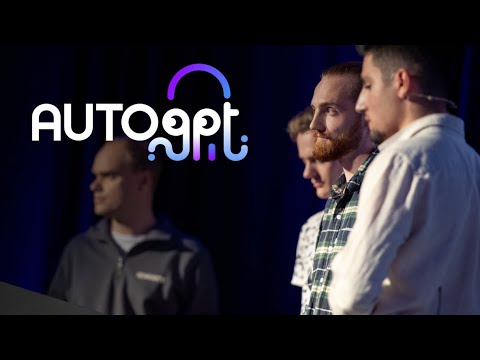
At the 2023 AI Engineer Summit, Richards introduced an AutoGPT team presentation featuring Silen Naihin and Poots. Their shared presentation addressed interoperability, agent benchmarks, developer interfaces, prompt-injection risks, and the challenges of safely delegating digital work.
By 2024, Richards had expanded the original developer-oriented experiment into the AutoGPT Platform, combining visual workflow construction, reusable agents, and managed or self-hosted deployment.
- Autonomous task execution: Language models become operational software when surrounded by explicit goals, tools, feedback, and repeated execution.
- Specialized agents over a single generalist: Richards’s Agent Blocks approach divides complex workflows among coordinated specialists, treating orchestration as central to capability.
- Continuous agent workflows: Agents should operate beyond individual chat sessions, respond to triggers, integrate with existing tools, and remain configurable and supervised.
- Explicit open-source licensing boundaries: AutoGPT’s classic agent uses the MIT license, while platform components use Polyform Shield, which allows personal and internal business use while restricting competing hosted services.