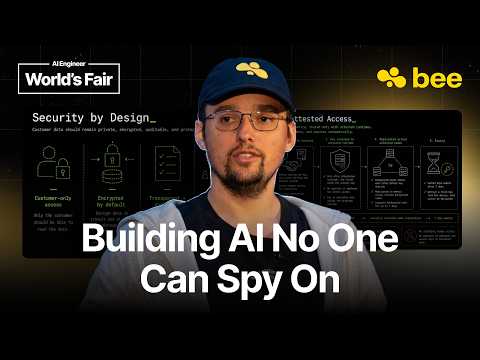
Steve Korshakov is a founding engineer at Bee, Amazon’s wearable personal-AI company, whose work spans encrypted messaging, programming languages, and autonomous coding tools. He designs assistants capable of remembering private conversations and acting independently without handing their operators unrestricted access to customers’ lives.
Earlier in his career, Korshakov worked at JetBrains and Telegram and led the messaging venture Actor. He later co-founded Openland, a Y Combinator-backed communications platform, serving as chief technology officer. He also contributed to Tact, a statically typed smart-contract language and compiler for the TON blockchain.
At Bee, Korshakov helped build a wearable assistant that translates conversations into personal context and suggested actions. After Bee joined Amazon, his security architecture confronted an additional challenge: protecting customer information from access within the company operating its cloud infrastructure.
Building private, autonomous systems
- Customer-controlled encryption keys: Keys originate on the customer’s phone and become available only to verified workloads. Scoped replication inside confidential-computing infrastructure and seven-day expiration allow the assistant to operate while its owner is offline without granting permanent access.
- Stateful autonomous agents: Korshakov envisions assistants with persistent memory, external tools, and workloads lasting hours or days. Bee runs its own inference infrastructure to avoid transmitting sensitive information unencrypted to external model providers.
- Enforceable agent sandboxing: Instructions alone cannot reliably prevent an agent from deleting files or taking destructive actions. Korshakov favors isolated execution, restricted permissions, established security components, and minimal custom security-sensitive code.
Korshakov also helps build Happy, an open-source mobile and web interface for coding agents including Claude Code and Codex. Its backend relays encrypted session data while users’ devices retain source code and decryption keys, extending his approach to encrypted coding-agent control.