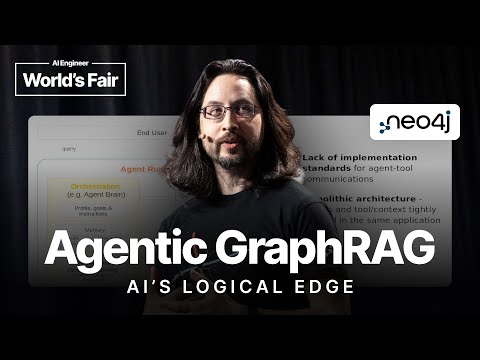
Stephen Chin is vice president of developer relations at Neo4j and coauthor, with Michael Hunger and Jesús Barrasa, of GraphRAG: The Definitive Guide. He develops the case for AI systems grounded in connected knowledge, persistent memory, and inspectable decisions.
From Java advocacy to graph-powered AI
Chin built his early reputation around Java developer education, technical books, conference programming, and projects such as JavaFX-Spring, which integrated JavaFX applications with Spring technologies. He worked in developer marketing and Java advocacy at Oracle, where he was director of developer marketing by 2018, before joining JFrog in 2019. He argued that commercially successful open-source ecosystems depend on supporting the companies and maintainers creating their underlying software.
At JFrog, Chin became vice president of developer relations and served on the governing boards of the Continuous Delivery Foundation and Cloud Native Computing Foundation. At Neo4j, he applies that background in developer education, open-source governance, and software infrastructure to knowledge graphs and enterprise AI. He also serves on the LF AI & Data Foundation board.
- GraphRAG combines similarity with relationships. Chin uses vector search to identify promising entry points, then graph traversal to recover diagnoses, dependencies, prior decisions, and other connected facts. His agentic GraphRAG architecture treats embeddings and knowledge graphs as complementary; semantic similarity alone cannot establish which evidence is relevant.
- Agent memory should preserve reasoning, not just conversation. His approach separates short-term activity, persistent domain knowledge, and decision histories. Context graphs connect policies, approvals, risk factors, and previous outcomes, giving people a basis for auditing an automated recommendation.
- Multi-hop reasoning makes operational answers actionable. Chin demonstrated how successive graph queries can connect a Jackson-library vulnerability to affected versions and remediation steps. In a home-network security demonstration, graph-backed retrieval identified outdated internet-exposed software and vulnerable management interfaces that vector-only retrieval failed to assemble.