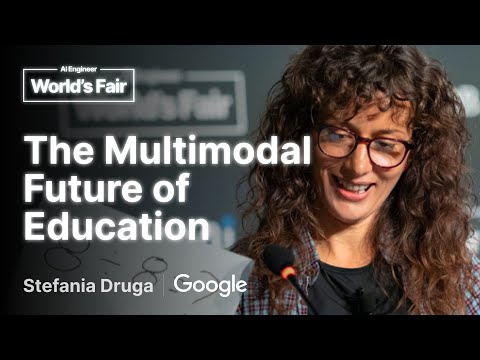
Stefania Druga is a staff research scientist at Sakana AI’s Recursive Self-Improvement Lab in Tokyo and the creator of Cognimates, an open-source platform that teaches children to program robots and train machine-learning models. Her research spans creative AI literacy, sensor-equipped scientific assistants, and memory architectures for autonomous research agents.
Druga began researching children’s interactions with intelligent technologies in 2015 at the MIT Media Lab, where she earned her master’s degree and developed Cognimates. Her 2018 MIT thesis examined how programming and training AI systems changed the understanding of 107 children across four countries.
She subsequently earned a doctorate in Creative AI Literacies at the University of Washington Information School. Her earlier work included maker-education initiatives Hackidemia and Afrimakers, a research fellowship at the Weizenbaum Institute, product engineering at Fixie.ai, human-AI interaction research at Microsoft, and a principal researcher position at the University of Chicago’s Center for Applied AI Research. She worked at Google DeepMind before joining Sakana AI’s Recursive Self-Improvement Lab.
- Creative AI literacy through making. Cognimates extends Scratch with visual programming, robotics, and custom image and text classifiers. Children can train a model to distinguish unicorns from narwhals, inspect its confidence, and improve its training examples when drawings confuse it. Building and testing these systems helps learners question the intelligence they attribute to familiar AI tools.
- Learner agency in AI-assisted coding. Cognimates Scratch Copilot, developed with Amy J. Ko, supports brainstorming, debugging, code explanations, and image generation without taking ownership of a child’s project. An exploratory study with 18 children emphasized adjustable support, transparent limitations, and the freedom to reject suggestions. Earlier research with Nancy Otero evaluated language-model assistance for families learning Scratch.
- Real-time AI co-scientists. Druga built a scientific assistant connecting micro:bit and Jacdac sensors, cameras, and microscopes to Gemini through React and WebUSB. Crystal-growth experiments combined live temperature and humidity measurements, microscopy, experimental protocols, and subsequent data analysis. The prototype is distinct from Google’s separate AI co-scientist system and emphasizes affordable, open laboratory hardware.
- Ranked recall for long-running research agents. Her on-device memory experiments combine persistent traces, archival storage, vector retrieval, and decision ledgers. Evaluations on XBench and Spider 2.0 found that ranked recall improves retrieval when essential information falls outside the context window; when the complete task still fits, additional memory increases cost without improving performance. Running quantized models locally also gives researchers direct control over evaluation data, execution traces, and the tradeoffs involved in sovereign AI.