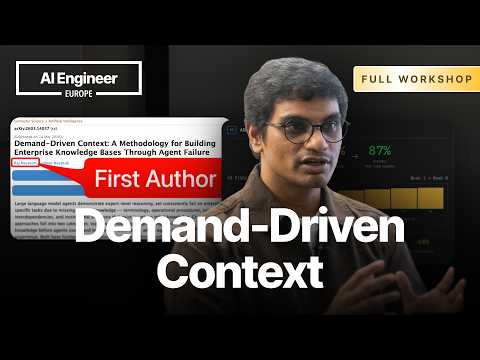
Raj Navakoti is a software engineer and enterprise architect who developed Demand-Driven Context, a method for helping AI agents acquire the organizational knowledge necessary to complete practical work. His central concern is that capable models cannot resolve enterprise incidents or finish delivery tasks when essential information is scattered, outdated, contradictory, or undocumented.
Navakoti studied at Jawaharlal Nehru Technological University, Kakinada, and worked across startups and larger enterprises before concentrating on logistics, delivery systems, and domain-driven design. At AI Engineer Europe 2026, he described his work as a staff software engineer in IKEA’s Delivery and Services domain. His interests in software architecture, neuroscience, and linguistics inform his approach to how organizations structure and communicate knowledge.
- Demand-Driven Context: Navakoti and Saideep Navakoti formalized their approach in a 2026 research preprint. An agent attempts a concrete operational task, identifies the knowledge it lacks, receives targeted input from a domain expert, and saves that information for future use. Like test-driven development, the method treats failure as a precise signal for what to build next. Their synthetic retail-fulfillment example generated 46 structured knowledge entities across nine cycles; broader enterprise-scale effectiveness remains unproven.
- Institutional knowledge engineering: Retrieval tools cannot recover business rules, architectural decisions, and operational dependencies that nobody has recorded. Navakoti uses incidents and work items to expose missing, stale, duplicated, or contradictory documentation, then prioritizes gaps by their relevance to actual tasks. His conference workshop demonstrated these ideas through root-cause analysis, knowledge-gap scanning, and repeated agent failures.
- Git-native knowledge governance: His open-source framework organizes curated context using existing GitHub review, permissions, version-control, and collaboration workflows. Its templates, cycle logs, and context-gap scanner make agent-discovered knowledge inspectable and reusable without requiring a separate enterprise platform.
- Navigable domain models: Navakoti maps relationships among systems, APIs, business processes, teams, and terminology so agents can understand operational dependencies. His Architecture Catalog translates structured documentation into searchable architecture views and dependency graphs; his Claude Code visualization dashboard similarly makes agent configurations easier to inspect.
Navakoti recommends starting with one team’s incidents and documentation because expert attention is limited, documentation changes, code and written guidance can conflict, and organization-wide deployments introduce unresolved coordination costs.