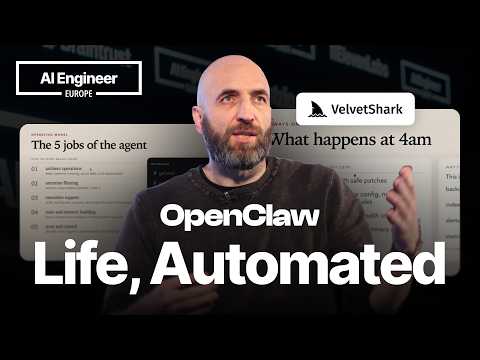
Radek Sienkiewicz is an OpenClaw maintainer and the creator of VelvetShark, where he builds and documents personal AI-agent systems. He specializes in making always-on assistants dependable: preserving memory, limiting permissions, automating routine work, and matching model costs to actual tasks.
Sienkiewicz has more than 15 years of experience in conversion optimization, which shapes his insistence that AI produce measurable practical benefits. Before concentrating on agents, he developed educational materials for decentralized-data infrastructure, including guides to ComposeDB query filtering and Ceramic protocol interfaces. His subsequent projects included SummerIce, a browser extension for summarizing articles, and Banana Straightener, an experiment in self-correcting image generation.
He initially approached OpenClaw as a user, adding capabilities gradually and submitting fixes when his workflows broke. Those contributions led to his maintainer role. He also created Clawdiverse, a directory of community use cases for OpenClaw.
Building agents that survive everyday use
- Durable, inspectable agent memory: His personal assistant searches an Obsidian vault containing approximately 3,000 Markdown notes, linking projects, research, tasks, and saved articles. His memory guide addresses conversation compaction by preserving important decisions and instructions in editable files, using explicit operating rules and deliberately maintained knowledge stores.
- Incremental trust and bounded autonomy: His setup expanded from WhatsApp to Telegram and Discord, acquiring access to files, calendars, communications, and operating-system tools one step at a time. It can flag urgent messages and draft contextual email replies, while leaving final approval to its operator. He identifies prompt injection as a persistent risk when assistants handle untrusted material.
- Multi-model routing and deterministic automation: Sienkiewicz assigns demanding interpretive work to stronger models and routine background tasks to cheaper ones, an approach detailed in his model-routing guide. Conventional scripts handle predictable operations; language models handle ambiguity and contextual judgment. Overnight processes refresh indexes, create backups, prepare briefings, and check updates.
His account of extended OpenClaw use also documents brittle automations, unreliable browser interactions, memory failures, security exposure, and accumulating costs. The objective is optimizing for your future self: reducing tomorrow’s work without surrendering oversight or creating fresh operational problems.