← All speakers

Bio, Work & Ideas

Mike Chambers

Conference affiliation: Senior Developer Advocate for Generative AI · Amazon Web Services (AWS) · 2026

Mike Chambers is a Brisbane-based Senior Developer Advocate for Generative AI at Amazon Web Services whose work focuses on turning language models into reliable, deployable agents. His projects and teaching address the engineering problems that begin when models interact with external tools: preserving context, managing asynchronous work, securing infrastructure, and operating systems in production.

Chambers previously worked in solutions and security architecture across enterprises and government before becoming an independent cloud and machine-learning trainer. AWS recognized him as an AWS Machine Learning Hero in 2020; he subsequently joined the company and shifted his focus from machine learning to generative AI. He helped develop and teaches Generative AI with Large Language Models, produced with DeepLearning.AI and AWS, and teaches serverless agentic workflows with Amazon Bedrock.

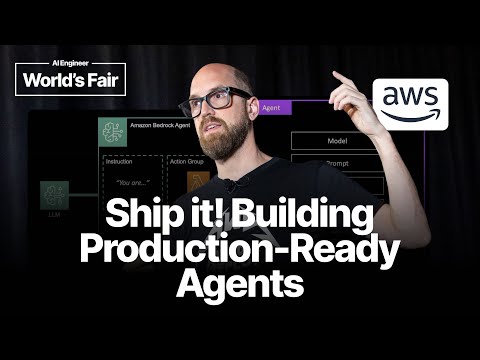
  • Production agents need working memory. Chambers defines an agent through five practical components: a model, instructions, a reasoning loop, conversational history, and tools. Crucially, history must persist between tool calls within the same task, allowing each step to build on earlier results. His production-agent demonstration develops this architecture from a local dice-rolling program into an Amazon Bedrock application backed by AWS Lambda and infrastructure as code.
  • Serverless Model Context Protocol infrastructure. His Lambda-MCP-Server exposes agent tools over HTTP without maintaining a continuously running server; its handler subsequently moved into the AWS Labs MCP project.
  • Truly asynchronous agent tools. The async-agentic-tools project returns immediately when background operations begin, keeps the conversation responsive, and delivers completed results through callbacks. The approach is particularly relevant to voice assistants, where blocking on slow tools creates awkward silence.
  • Infrastructure OpSlop. Chambers uses this term for agents that create cloud resources through unreviewed, imperative actions without reproducible definitions. His case for agent-generated infrastructure as code advocates version-controlled templates, reviewed changes, limited permissions, and clear deployment boundaries; related work explores sandboxed tool orchestration without unrestricted access to networks, files, or secrets.

Read the topics behind these talks

2 conference talks

References