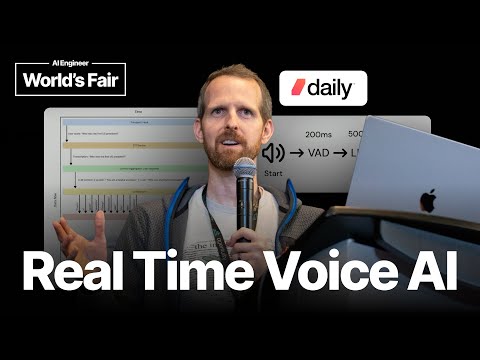
Mark Backman leads product at Daily and helps build Pipecat, an open-source framework for real-time voice and multimodal agents. His work focuses on the engineering decisions that make conversational software usable: response latency, speech recognition, natural turn-taking, and reliable deployment across interchangeable AI providers.
Before concentrating on voice agents, Backman specialized in streaming video applications, real-time communications, and developer-facing SDKs. His writing on video-call quality and browser compatibility addressed practical challenges involving cameras, WebRTC, and user experience. At Daily, that experience expanded into building the infrastructure required for live conversations between people and AI systems.
In January 2026, he co-authored the launch announcement for Pipecat Cloud, a managed platform for deploying Pipecat applications with autoscaling, distributed infrastructure, telephony, and observability. Following a beta involving more than 1,000 teams, the platform introduced managed deployment without vendor lock-in while preserving developers’ ability to self-host their applications.
- Composable voice-agent pipelines. Backman approaches voice applications as coordinated systems combining audio transport, transcription, language models, speech synthesis, conversation state, and tools. Pipecat supports interchangeable providers and native speech-to-speech models; even when a single model handles audio directly, applications still require orchestration for recording, context, integrations, and operational control.
- Semantic Word Error Rate. His speech-recognition benchmark evaluates whether transcription errors actually change meaning, alongside the time required to finalize an utterance. Comparing 10 services against 1,000 real-world English speech samples, the open-source benchmark distinguishes harmless formatting differences from mistakes involving names or consequential instructions. It also examines P95 and P99 latency, capturing disruptive delays that median measurements conceal.
- Semantic turn detection. Backman contributes to Smart Turn, an audio-based model that helps agents distinguish a completed thought from a momentary pause. Combining voice activity detection with contextual and acoustic cues helps conversational systems avoid interrupting people while they hesitate or think.
- Production architecture grounded in conversation. Backman favors WebRTC for interactive client connections and WebSockets for server-to-server communication or telephony. He advocates structuring conversations into discrete tasks, trimming unnecessary context, and weighing external tool calls against their latency. While building a conversational assistant for the AI Engineer World’s Fair, he confronted a practical tradeoff: placing speaker information directly in model context improved responsiveness but increased the risk of confusion among similar records. His real-time voice AI workshop demonstrates how those architectural decisions shape the quality of each conversational turn.