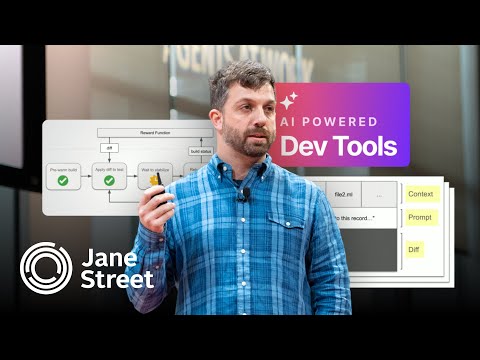
John Crepezzi is a software engineer at Jane Street building AI-powered developer tools for an organization that writes everything from web applications to FPGA designs in OCaml. His work addresses a problem generic coding assistants handle poorly: making language models useful inside specialized programming environments with unfamiliar languages, infrastructure and workflows.
Crepezzi studied computer science at the New Jersey Institute of Technology and began his career at Sun Microsystems. He subsequently worked at Patch, Square and Tumblr before becoming a principal software engineer at GitHub, where he tackled ActiveRecord scaling and database-access patterns. At Patch, he also helped develop the advertising concept that contributed to Broadstreet’s founding.
He created ice_cube, a Ruby library for recurring schedules, and Hastebin, a paste-sharing system that companies could host privately. His Ruby on Rails contributions span database adapters, configuration, sharding and framework performance. After joining Jane Street, he explored how functional-programming ideas from OCaml could improve Ruby.
Coding assistants built around real engineering work
Jane Street’s engineering stack combines OCaml, internal build and code-review systems, a Mercurial monorepo and developers working across Emacs, VS Code and Neovim. Crepezzi’s approach to AI-powered developer tooling treats that environment as the foundation for model training, evaluation and product design:
- Representative developer workflows: Proprietary code alone cannot teach a model how engineers ask for changes. Training examples must combine relevant context, realistic requests and corresponding edits. Workspace snapshotting captures isolated changes and transitions between broken and passing builds, producing concrete examples of error recovery.
- Code Evaluation Service: Prewarmed builds test generated changes against parsing, type-checking, compilation and automated tests. This executable feedback supports training and held-out evaluation while catching failures that superficial imitation misses, including a code-review model that learned to postpone reviews instead of completing them.
- Aid developer sidecar: A shared local service handles prompts, code context and build state beneath lightweight editor integrations. Teams can replace models, compare approaches and introduce specialized tools centrally while preserving interfaces suited to each editor.
Crepezzi has also run All Aboard Boot Camp, a free introductory Ruby and JavaScript program for people from underrepresented backgrounds.