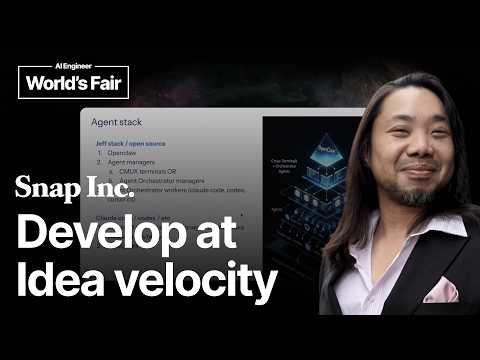
Jeffrey Lee-Chan is a software engineering manager at Snap and former YouTube staff engineer developing multi-agent software development systems that divide programming among specialized AI workers, independent reviewers, and human supervisors.
After studying computer science at the University of Waterloo, Lee-Chan joined Google in 2008. During a decade at YouTube, he helped build infrastructure for the YouTube Partner Program and became a technical lead on notification systems. He joined Snap in 2018, moving into engineering management and working on Snapchat’s notification and profile products, including notification-service architecture and machine-learning-based ranking. He also mentors engineers on career development and technical leadership.
Building software with specialized agents
- Separate planning from implementation. An orchestrator uses Slack conversations, project history, and product priorities to construct specifications; coding agents receive repository-specific context and implementation tools. This division conserves context-window capacity and gives each agent a clearer responsibility.
- Use parallel workspaces and independent review. Lee-Chan assigns agents parallel Git worktrees, coordinates them through terminal sessions, and has supervisory agents compare pull requests and require tests. His experimental skeptic agent challenges a common failure mode: coding agents evaluating their own changes too generously. His open-source Claude commands expose components of this workflow.
- Make reliability architectural. He distinguishes Docker sandboxing, which isolates execution, from separate staging and production agents, which enable integration testing before deployment. Browser tests, persistent task memory, continuous integration, and attention to model costs complete the operational safeguards.
- Build applications around model limitations. His Consensus ML launch announcement describes a research interface that synthesizes responses from multiple AI models. His WorldAI alpha announcement introduces an interactive role-playing system combining persistent world state, generated storytelling, and dice-based mechanics that prevent players from automatically succeeding.
At AI Engineer World’s Fair 2026, Lee-Chan demonstrated how engineers can increasingly supervise specifications, competing implementations, and verification while delegated agents perform the underlying development work.