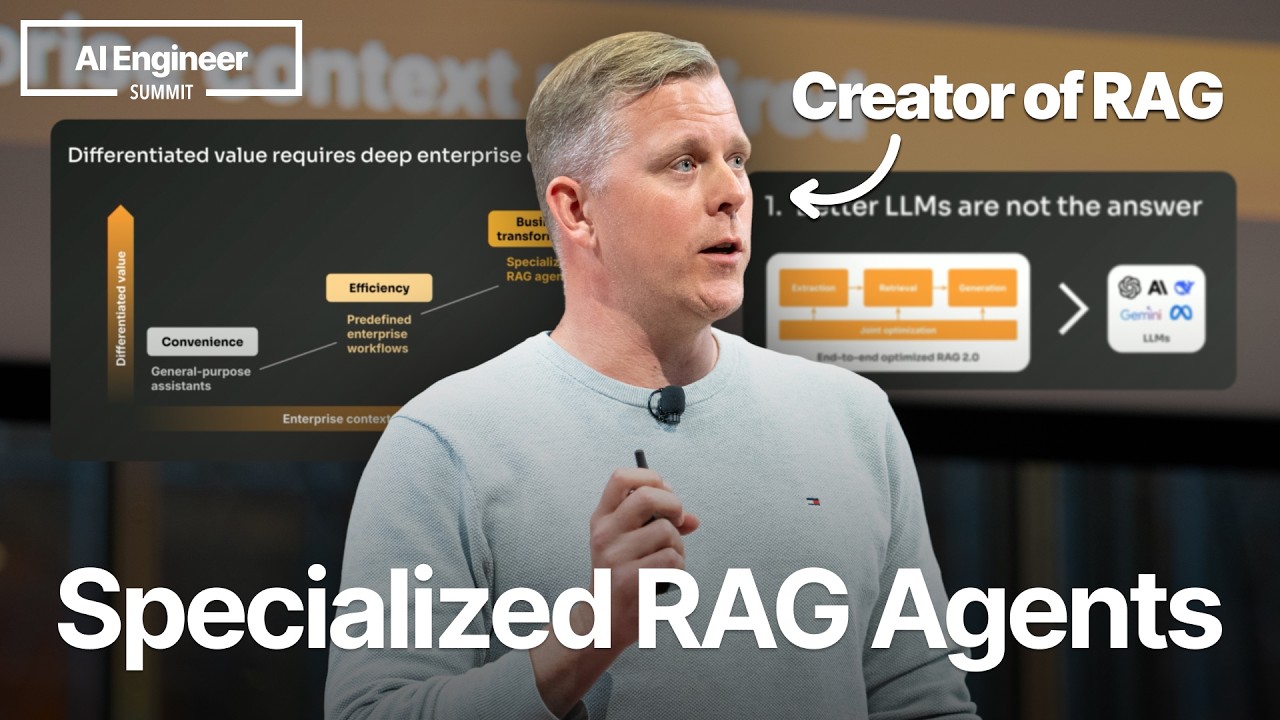
Douwe Kiela is a Google DeepMind researcher, co-founder and former chief executive of Contextual AI, and co-author of the foundational 2020 paper on retrieval-augmented generation. His research helped establish how language models can draw on external documents; his subsequent company applied that architecture to specialized enterprise agents.
Kiela studied cognitive artificial intelligence and philosophy at Utrecht University, logic at the University of Amsterdam, and completed an MPhil and doctorate at the University of Cambridge. He has also served as an adjunct professor in Stanford’s Symbolic Systems program.
At Facebook AI Research, he co-authored the original RAG paper, which combined a pretrained language model with retrieved external knowledge, enabling answers grounded in information beyond the model’s parameters. He also led research introducing Dynabench, a platform for dynamic, human-in-the-loop evaluation that challenges static benchmarks by having people continually probe model weaknesses.
He later became head of research at Hugging Face, where he helped establish an AI research residency and contributed to work on language-model bias and multimodal research ethics. In 2023, he co-founded Contextual AI with Amanpreet Singh, a collaborator from Facebook AI Research and Hugging Face. As chief executive, he oversaw the general availability of its enterprise platform in January 2025 and the introduction of Agent Composer in January 2026.
- The enterprise context paradox: Models can excel at coding or mathematics while failing at organizational work because they lack proprietary knowledge, accumulated expertise, and situational context.
- Specialization over general-purpose intelligence: Domain-specific agents grounded in enterprise documents and workflows can outperform generic assistants on demanding professional tasks.
- Production systems over standalone models: Retrieval, document processing, security, compliance, usability, and workflow integration collectively determine whether an AI product delivers value. Kiela advocates designing for noisy data and production scale from the outset.
- Attribution as a condition of trust: Evaluations, observability, audit trails, and document-backed claims make consequential errors easier to detect and investigate.
- Real users before polished demos: Early deployment and direct feedback expose practical obstacles that controlled pilots miss. At Qualcomm, a specialized agent surfaced an overlooked internal technical document, illustrating how retrieval can unlock institutional knowledge that employees struggle to find.
These positions inform his approach to specialized RAG agents: build systems around evidence, professional expertise, and actual organizational use.