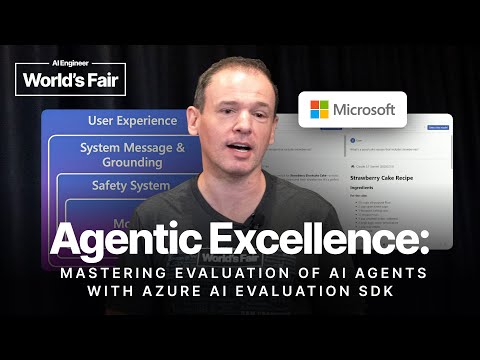
Cédric Vidal is a Principal Cloud Advocate at Microsoft focused on agentic experience optimization: making autonomous AI systems dependable as they move from answering questions to completing complex, multistep tasks. His background spans financial software, fraud prevention, autonomous vehicles, and the infrastructure required to evaluate systems whose decisions have real consequences.
After approximately a decade consulting for financial-services companies, Vidal became chief technology officer of Quicksign in 2014. He led work on digital customer onboarding, document recognition, and fraud prevention as the company expanded from rules-based processing and optical character recognition into machine learning.
In 2019, he joined Argo AI, managing engineering teams responsible for machine-learning infrastructure, data-labeling tools, and autonomous-vehicle production pipelines. He later worked as a staff software engineer on workflow orchestration. Following Argo’s closure in 2022, he shifted toward language models, embeddings, retrieval, and copilots; his professional résumé traces his move to Microsoft startup advocacy in 2023 and principal cloud advocacy in 2026.
His RAFT Distillation Recipe combines document-derived synthetic examples, larger teacher models, fine-tuning, and evaluation to adapt smaller models to specialized tasks. His writing on production-data distillation extends that approach to real application interactions while identifying privacy, data-quality, and evaluation constraints.
What makes an agent trustworthy
- Evaluate complete agent behavior. Vidal argues that evaluation should begin during application design and measure more than answer quality: grounding, relevance, tool selection, execution traces, and reliability across repeated runs. His Azure AI Evaluation SDK work connects model comparisons with representative datasets and automated scoring.
- Treat function calling as function routing. A language model proposes a tool and structured arguments; application code executes the operation. Keeping that boundary explicit improves control over permissions, security, and debugging when agents touch databases, files, or external systems.
- Use specialized-agent routing deliberately. Overloading one agent with tools increases the chance of incorrect selection. Vidal favors routing requests to narrower agents, while warning that autonomous loops require explicit stopping criteria and can produce inconsistent results.
- Ground agents in data and enforce conventional security. His systems combine SQL, PDFs, vector search, browser automation, and visualizations; sensitive information still requires access controls beyond prompt instructions. His analysis of the GoEX research project examines constrained execution and keeping credentials away from models.
Vidal also organizes San Francisco practitioner events including AI Show + Tell. His practical examples range from interpreting handwritten menus to analyzing kitesurfing GPS data and generating sales dashboards, consistently distinguishing impressive demonstrations from systems that can be inspected, evaluated, and operated safely.