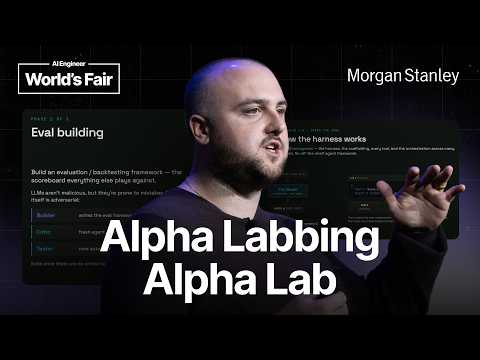
Brendan Rappazzo is an applied researcher at Prime Intellect developing open models, reinforcement-learning methods, and autonomous research systems. Previously a machine-learning scientist at Morgan Stanley, he helped build AlphaLab, a multi-agent platform for quantitative research that treats rigorous evaluation as the foundation of useful automation.
From environmental science to open-model research
Rappazzo studied bioengineering and biomedical engineering at the University of Maryland, College Park, before earning a master’s degree and doctorate at Cornell University. Working with Carla Gomes on computational sustainability, he contributed to Phase-Mapper, an award-winning materials-discovery system, and developed computer-vision methods for measuring eelgrass disease. His research also addressed hydropower planning in the Amazon.
His subsequent work investigated how machine-learning systems recognize and correct their own mistakes. He coauthored Critic Loss for Image Classification, which uses a learned correctness critic to improve classification and calibration with limited labeled data; the research received ICMLA’s 2024 best-paper award. He also coauthored GEM-RAG, a retrieval architecture built around graph-structured memories and higher-level summaries.
After completing his doctorate, Rappazzo joined Morgan Stanley’s machine-learning research group. There, AlphaLab combined frontier language models with domain research, evaluation construction, and large-scale experimentation. Its strategist proposes hypotheses while worker agents implement models, launch Slurm-managed compute jobs, inspect training results, and refine subsequent experiments; human researchers can intervene and compare candidates against held-out data. His AI Engineer World’s Fair presentation detailed applications spanning time-series forecasting, CUDA kernels, and language-model training.
In August 2026, Rappazzo left Morgan Stanley and joined Prime Intellect’s applied research team, advocating open-source intelligence that lets individuals and organizations train and control their own models.
- Evaluation environments as durable expertise. Rappazzo argues that autonomous research capabilities will become widely available, while carefully constructed environments retain scarce domain knowledge. Held-out datasets, leakage-resistant scoring, containerized submissions, and qualitative research rubrics make experimentation measurable and can provide reinforcement-learning signals for improving the research system itself.
- Critic-guided learning. His classification research uses learned estimates of prediction correctness to improve calibration and identify promising examples for human labeling, connecting model reliability with semi-supervised and active learning.
- Open reinforcement-learning experiments. DeepSeekRL-Extended exposes a GRPO-style training loop, reward functions, and evaluation machinery for hands-on experimentation.
- Adversarial and persistent agents. Loophole uses competing agents to probe weaknesses in legal principles, system prompts, and chatbot policies. HermitClaw explores a continuously running agent that researches topics, writes reports, and retains memory across tasks.