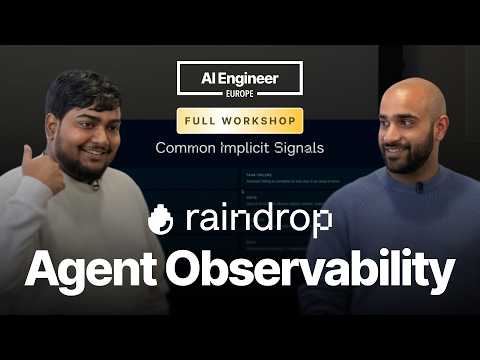
Ben Hylak is co-founder and chief technology officer of Raindrop, which builds tools for finding, investigating, and repairing failures in production AI agents. His work combines interface design with operational reliability: making open-ended software understandable to users and its unpredictable behavior diagnosable to engineers.
From spatial computing to agent infrastructure
Hylak completed avionics engineering internships at SpaceX before joining Apple, where he worked in engineering and human-interface design and helped develop the first version of visionOS for Apple Vision Pro. Spatial computing forced him to confront situations conventional interfaces seldom encounter: applications following users between rooms, accommodating different physical abilities, and remaining coherent in environments designers cannot fully anticipate.
After Apple, he worked with Zubin Koticha and Alexis Gauba on Sidekick, a Visual Studio Code extension. Their experience building AI software exposed a practical blind spot: conventional monitoring could identify exceptions but struggled to explain plausible answers that misunderstood users or quietly failed. The team subsequently built Dawn, an AI analytics company that evolved into Raindrop.
Hylak also developed a distinctive approach to reasoning models. His analysis of OpenAI’s o1 argued that stronger results depend on supplying detailed goals, relevant context, and explicit deliverables; his assessment of o3-pro, co-authored with Gauba, extended that principle to organizational context, tools, and model harnesses. Greater model intelligence does not eliminate the difficulty of communicating intent.
- Unbounded products need visible structure. Drawing on his work with visionOS and multimodal interfaces, Hylak argues that products accepting open-ended language, images, and environmental inputs require recognizable hierarchy, familiar controls, examples, and presets. Durable artifacts should remain separate from transient chat so users can continue working without losing the object they created.
- Raise the reliability floor. Hylak distinguishes an agent’s most impressive capability from its worst plausible behavior: deleting data, inventing policies, or taking inappropriate autonomous actions can destroy trust regardless of benchmark performance. His agent-evaluation guide favors targeted, code-aware regression tests grounded in real failures over brittle checks tied to particular tools or models.
- Make production failures actionable. Effective monitoring combines explicit signals such as tool errors and regeneration with implicit indicators including refusals, frustration, and unmet user intent. Hylak argues that an operational issue must reveal when it started and whom it affects; loosely grouped conversation clusters can conceal distinct causes and resist reliable tracking.
- Connect detection to verified repair. Raindrop Workshop provides open-source local tracing, replay, coding-agent debugging, and evaluation generation. Raindrop Triage investigates incidents through Slack, the web, and the Model Context Protocol. Together, they support a self-healing agent workflow that identifies failures, investigates their causes, proposes fixes, generates regression tests, and checks whether production behavior actually improves.