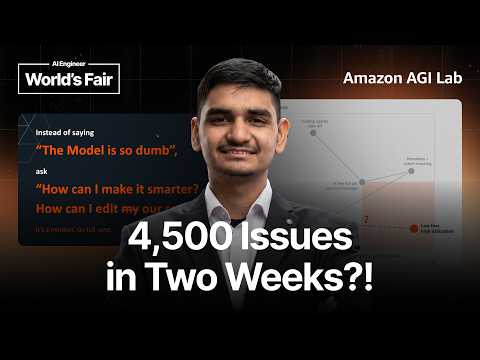
Aditya Khandelwal is a member of technical staff and technical lead at Amazon AGI, building research infrastructure for real-time multimodal agents. His work spans computer-use systems, training data, evaluation, and the engineering practices that help teams deploy AI coding agents reliably.
Khandelwal studied computer engineering at the College of Engineering Pune and coauthored NegBERT, a 2020 study applying transfer learning to negation detection and scope resolution. He subsequently investigated transformer-based detection of negation and speculation, including applications to biomedical text.
From 2020 to 2023, he worked at Microsoft on Bing Shopping, developing systems for product discovery, recommendations, and comparison. At Columbia University, he pursued graduate studies in artificial intelligence and business. He also founded Halo AI, an Android assistant designed to understand on-screen context, operate across applications, and prioritize on-device inference, and served as interim head of product at Instorify.
At Amazon AGI, Khandelwal developed T-Rec, which records and replays human computer-use sessions as training trajectories, and worked on evaluation infrastructure and the Nova Act SDK. His account of building browser-use agents connects research iteration with product judgment and engineering infrastructure. He also created an open-source Nova Act usability-testing skill that generates user personas, exercises website journeys, and produces usability reports.
How teams make agents dependable
- Adoption requires organizational ownership. Khandelwal argues that individual productivity gains can backfire when prolific agent users generate pull requests faster than colleagues can review them. Leadership must establish shared conventions and address engineers’ confidence and skepticism.
- Progressive disclosure controls agent context. His approach to harness engineering favors concise instruction indexes, nearby documentation, and code-linked runbooks that guide agents toward relevant information without overwhelming their context windows.
- ShipIt makes trust operational. His team built ShipIt, an agent skill that prepares pull requests, handles review comments, and addresses continuous-integration failures, giving engineers a concrete workflow they can trust without constant supervision.
- Quality requires closed feedback loops. He combines agentic reviews, CI/CD, issue tracking, and automated code gardening to detect generated-code problems and return corrections to the engineering process, while separating disposable experiments from production software. His AI Engineer World’s Fair presentation develops these practices through the realities of shared repositories and team-wide adoption.