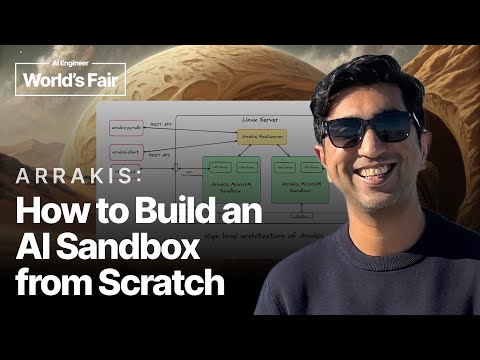
Abhishek Bhardwaj is an OpenAI infrastructure engineer and the creator of Arrakis, an open-source sandbox that lets AI agents execute code, operate computers, and recover from mistakes safely. He builds the security, storage, and orchestration systems that make autonomous software useful beyond a single prompt or machine.
After studying distributed systems and operating systems at Carnegie Mellon, Bhardwaj worked at Microsoft on Windows Subsystem for Linux and the Microsoft Band operating system. At Google, he spent eight years developing ChromeOS containers and virtualization, including helping create crosvm, a Rust-based virtual machine monitor that isolates guest operating systems behind hardware-enforced security boundaries.
At Replit, he worked on microVM sandboxes, AI-assisted coding, and developer infrastructure. He also co-authored the architecture behind Eval, a reverse WebSocket proxy that separated persistent client connections from container management to improve reliability and scaling.
He subsequently built Arrakis as its solo founder, combining secure code execution, browser access, filesystem recovery, and programmable sandbox management. He later joined OpenAI’s agent-infrastructure organization, working on reinforcement-learning infrastructure and secure execution environments supporting ChatGPT and Codex.
The infrastructure ideas behind his work
- Hardware-backed microVM isolation. Containers share their host kernel, leaving a route from untrusted agent-generated code to sensitive infrastructure. Bhardwaj favors microVMs with separate guest kernels and hardware-enforced isolation; Arrakis uses Linux KVM and Cloud Hypervisor. He accepts the resulting memory, performance, and GPU-sharing tradeoffs because recovering lost user trust is harder than optimizing a slower system.
- Snapshot-and-restore backtracking. Arrakis preserves both running memory and writable filesystem state, allowing agents to return to a working checkpoint after a failed multistep task. Its Model Context Protocol server makes that capability available to compatible agent clients. In one demonstration, an agent built a collaborative document application, added dark mode, and restored the earlier version.
- Persistent storage for long-running agents. Bhardwaj considers durable disks essential to agents performing extended work. Incremental snapshots, copy-on-write images, and block-level persistence preserve progress across machine failures, support migration between hosts, and let agents branch across alternative solutions without repeatedly copying entire environments.
- Fleet-scale sandbox orchestration. Reinforcement-learning systems prioritize throughput and parallel attempts; interactive products require fast startup and dependable recovery. Bhardwaj combines memory-snapshot provisioning, selective prewarming, and checkpoint-aware scheduling to distribute sandboxes efficiently while placing restored workloads near the data they already need.
His 2025 sandbox architecture walkthrough and 2026 account of fleet-scale agent infrastructure chart the evolution from individual secure environments to persistent clouds for autonomous work. He frames the challenge in first-principles terms: understand runtime isolation, make storage an agent capability, and orchestrate both reliably at scale.